At the end of September, I introduced StackingWizard and AstroWizard, Lukomatico's two free tools to stack and then process your images. About ten releases later, here is an update. On the RC Astro side, BlurXTerminator, NoiseXTerminator and StarXTerminator also changed a lot this summer.
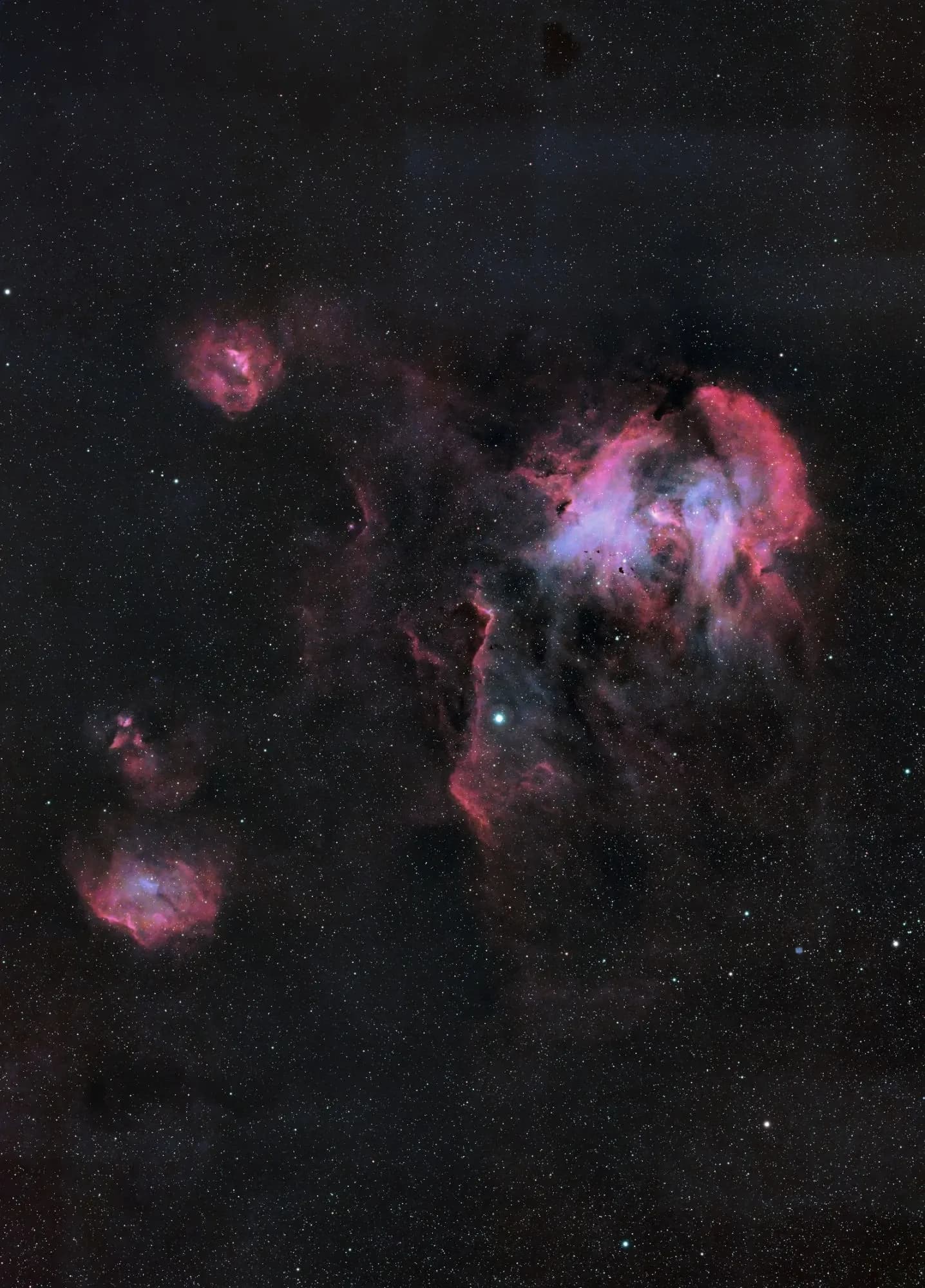
Test case: a mosaic of the Running Chicken Nebula (IC 2944) with the Seestar S50, 66 pointings, 2,259 frames of 20 s.
StackingWizard: beta 4.7 to 4.8
The interface speaks your language
Since beta 4.8 (17 October), StackingWizard is translated into 13 languages besides English. The translations are still partial: the step names (The Pile, The Looking Glass, The Stack, The Handoff) and some messages stay in English.
A 2,259-frame mosaic, with nothing to set
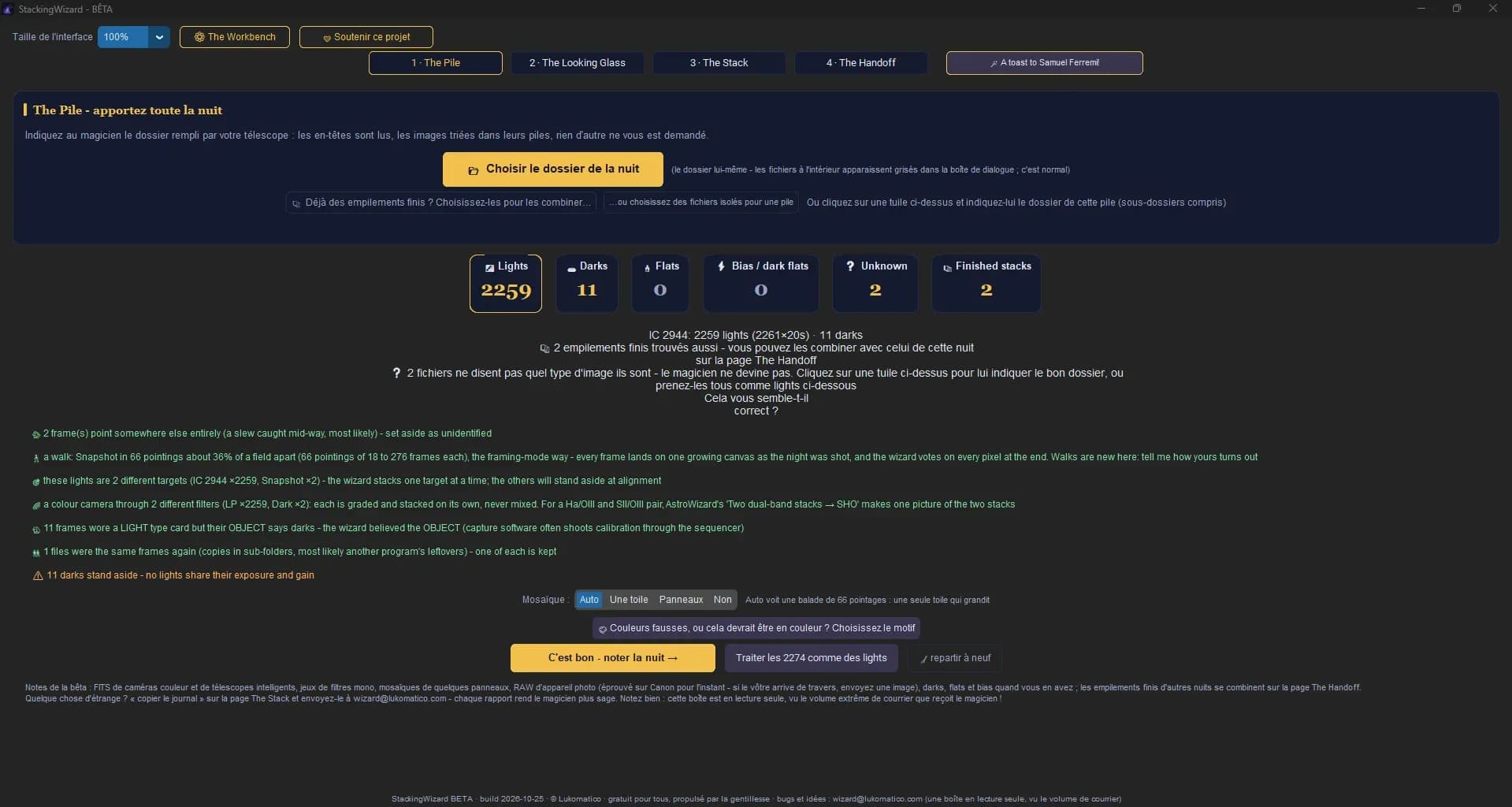
I gave it the night's folder. On its own, it found:
- 2,259 lights and the mosaic: 66 pointings laid on a canvas that grows through the night;
- 11 darks, set aside because no light shares their exposure and gain;
- 2 frames shot while the telescope was moving, set aside;
- 2 Seestar stacks, offered for combining later;
- 2 filters, processed separately.
Performance
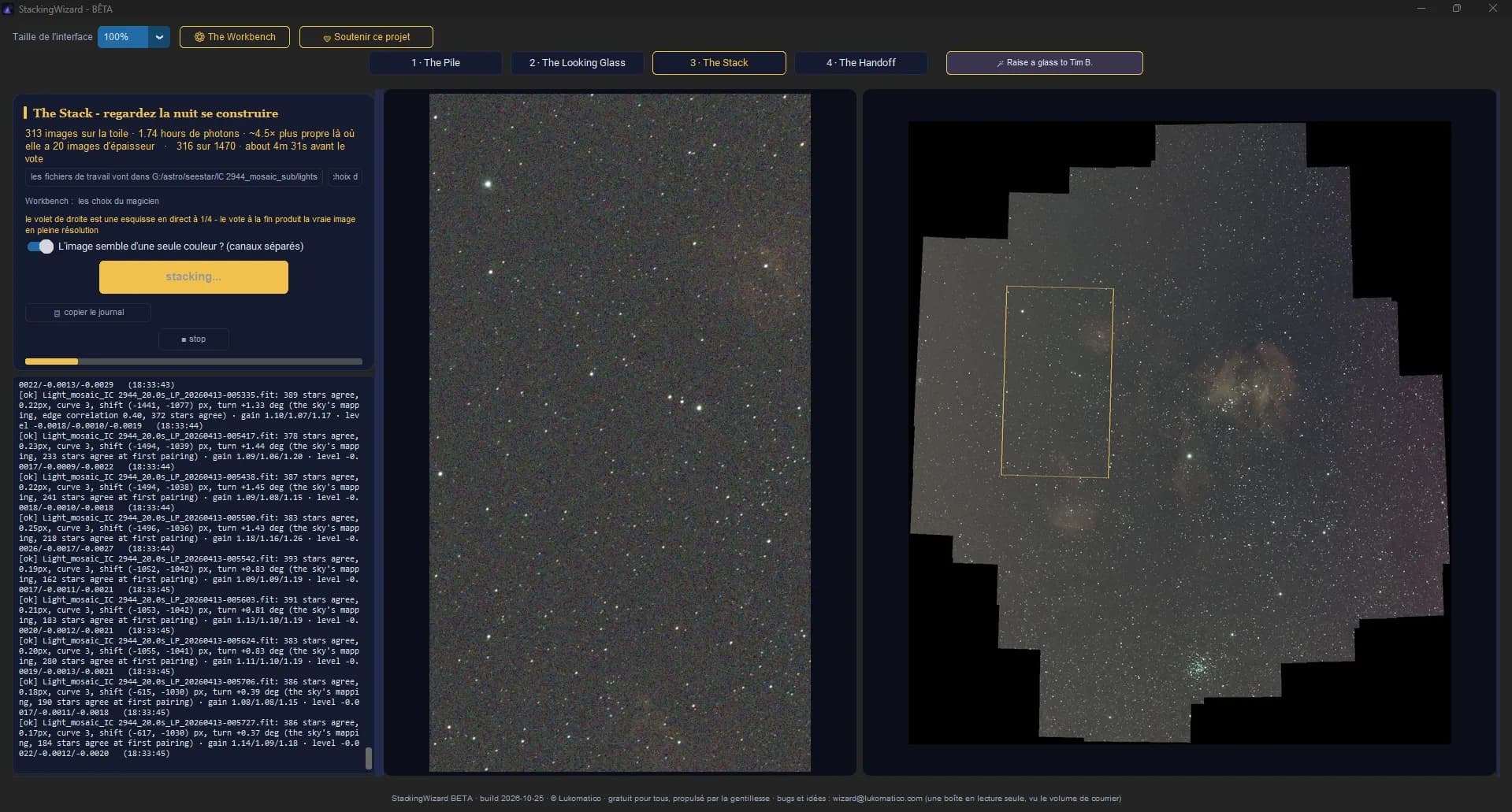
During stacking, the mosaic builds live on the right of the screen, with the current frame outlined in yellow.
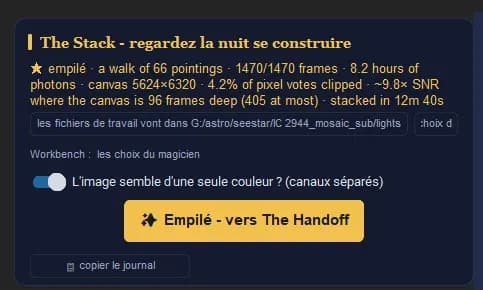
- 1,470 frames stacked out of 2,259 (The Looking Glass set 789 aside), or 8.2 h of exposure;
- a 5624 × 6320 pixel canvas (35 MP);
- a signal-to-noise ratio about 9.8 times better than a single frame where the mosaic is 96 frames deep (405 at most);
- in 12 min 40 s, with a Ryzen 5 9600X, 32 GB of RAM and an RTX 4070 Ti (12 GB).
Speed was the weak point in my first article. Not anymore.
One gap though: I didn't see any "feathering" option to blend the edges and remove the seam lines between frames in the mosaic.
Other changes
- Plane and satellite trails detected and outlined in gold in The Looking Glass. Only the trail is excluded, the rest of the frame is kept (4.7).
- Hot pixels fixed without darks, using the night's own frames (4.6). Handy here, as my darks didn't match.
- More reliable mosaics: fewer frames set aside when the telescope moves often, and no holes (4.7).
- The Moon no longer gets frames thrown out: each one is judged against its own sky background (4.7.1).
- The Handoff sends the whole mosaic to AstroWizard (4.7.1).
- Identical results from one stack to the next (4.7.1 and 4.8).
- Formats: NINA's .fits.fz, Unistellar "StackInput" frames (4.7).
- Manually Configure, a mode to set your own grading limits (4.8).
- The Workbench, the gold button at the top, gathers the advanced settings. Beginners can ignore it.
AstroWizard: the October releases
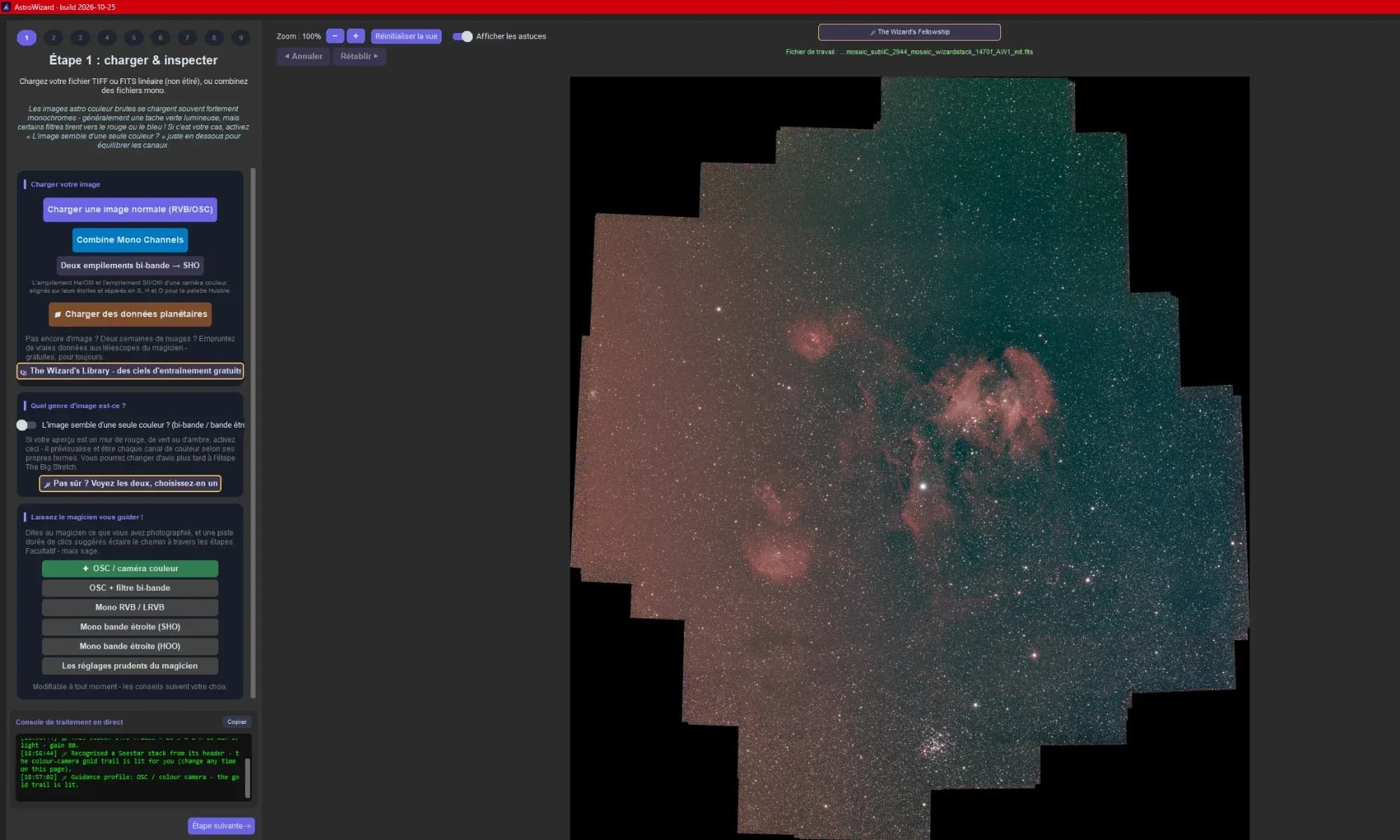
AstroWizard got the same languages on 17 October. It recognised a Seestar stack on its own and turned on the gold trail, which shows what to click at each step.
What's new:
- Signature (text or logo) on images saved as JPEG, PNG and TIFF;
- exposure summary on loading: total time, number of frames, gain;
- plate solving that shows north and whether the image is mirrored;
- true star colours (Gaia catalogue) on narrowband images too;
- manual GHS stretch with before/after comparison;
- processing replay exportable as MP4;
- adjustable High-Pass sharpening, a Bin 2x2 option for drizzle, BlurXTerminator before/after statistics.
Processing IC 2944
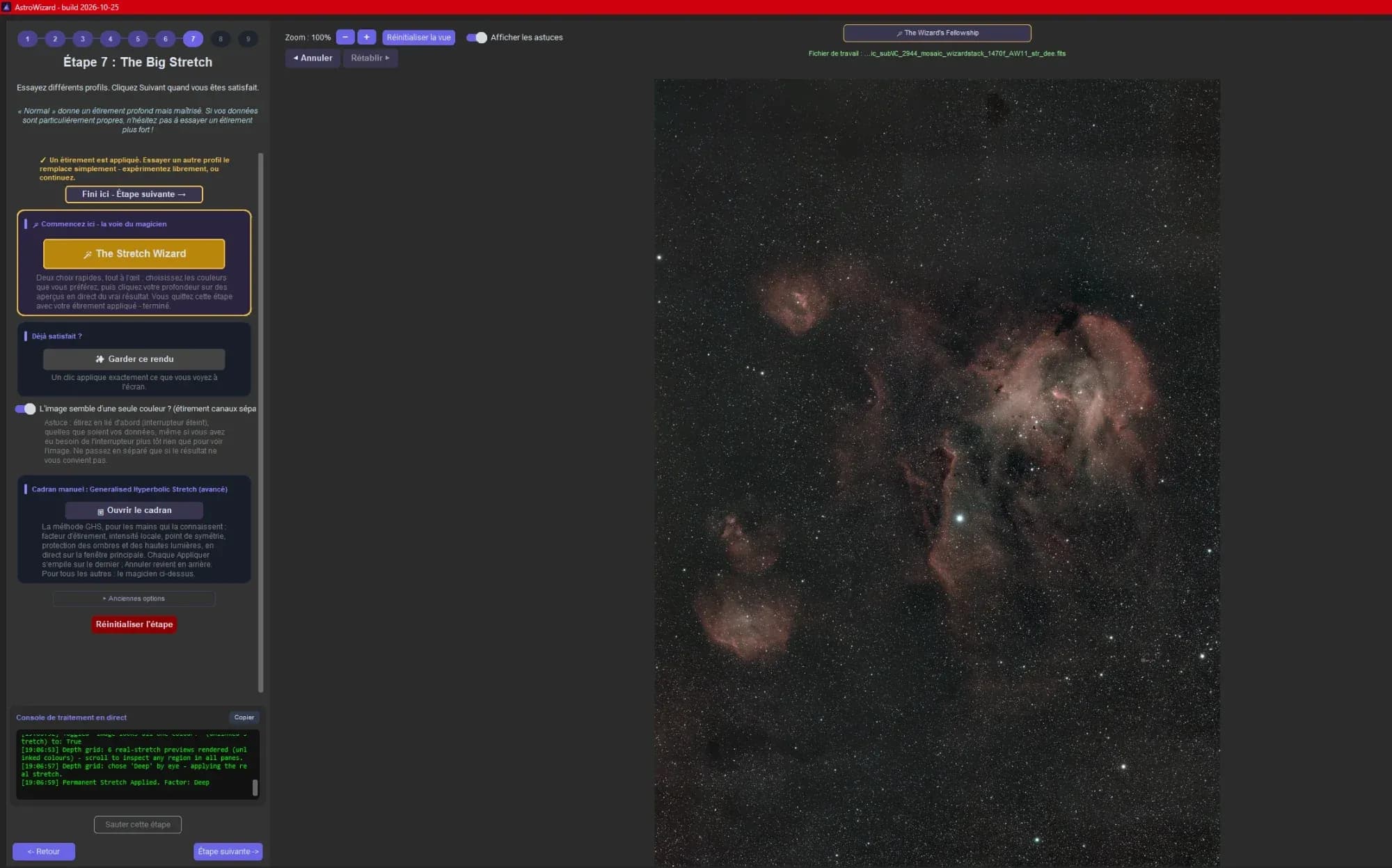
On step 7, I chose the "Deep" stretch, with colour channels stretched separately.
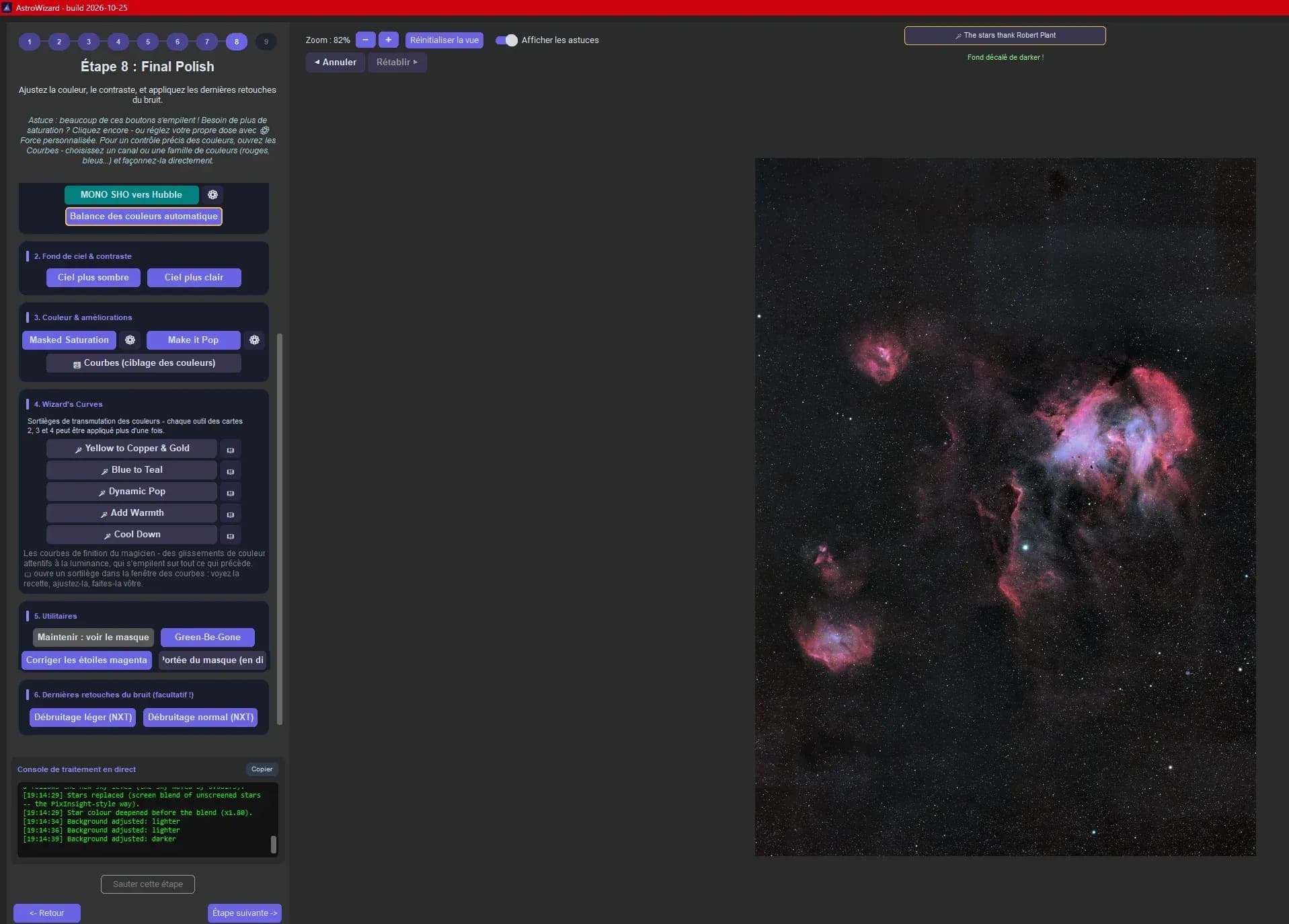
On step 8, a few clicks for the sky background, colours and stars. The green cast went away with the "Green-Be-Gone" button.
RC Astro: stand-alone tools and BlurXTerminator ML5
- Stand-alone tools (version 1.0.0 on 13 July): BlurXTerminator, NoiseXTerminator and StarXTerminator run without PixInsight or Photoshop. That's what lets AstroWizard, Siril or Seti Astro Suite Pro use them.
- RC Astro Suite (27 July): a single suite for PixInsight (1.8.9-2 to 1.9.5), with the same engine.
- BlurXTerminator ML5 (28 August): better on bright stars, dense fields, high-contrast objects such as M 42, small galaxies and star colour. New Lunar/Planetary mode. A model four times larger, about 20% slower. It needs the unified suite or the stand-alone tool 2.6.5 or later.
Paid upgrade: free if your licence is less than a year old, $49.95 otherwise. Your current licence stays valid, and there's a one-week trial.
What about PixInsight?
In PixInsight, I started from the file exactly as stacked by StackingWizard.
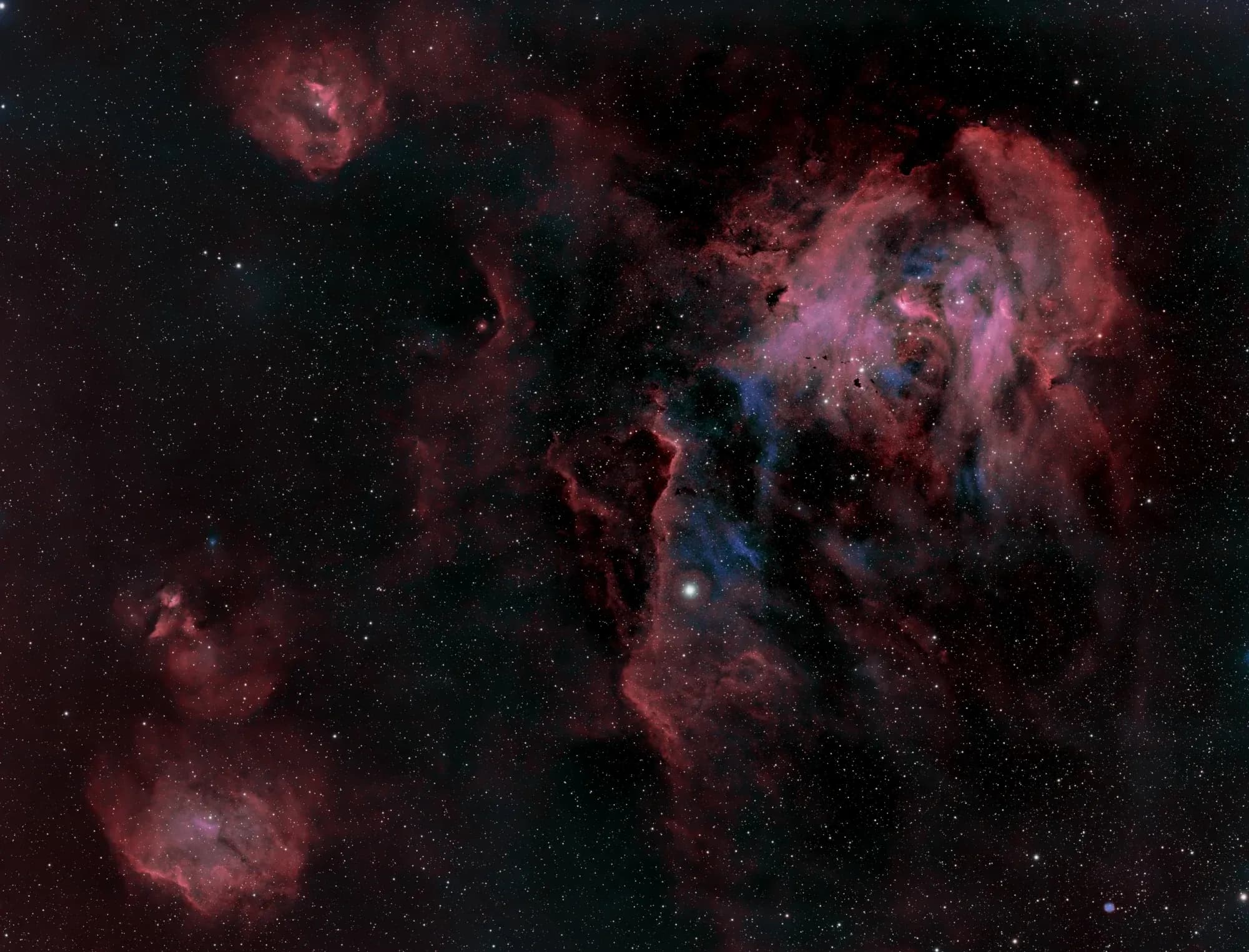
To be fair: in PixInsight, the RC Astro tools were up to date (BlurXTerminator ML5). In AstroWizard, they were still on their base version.
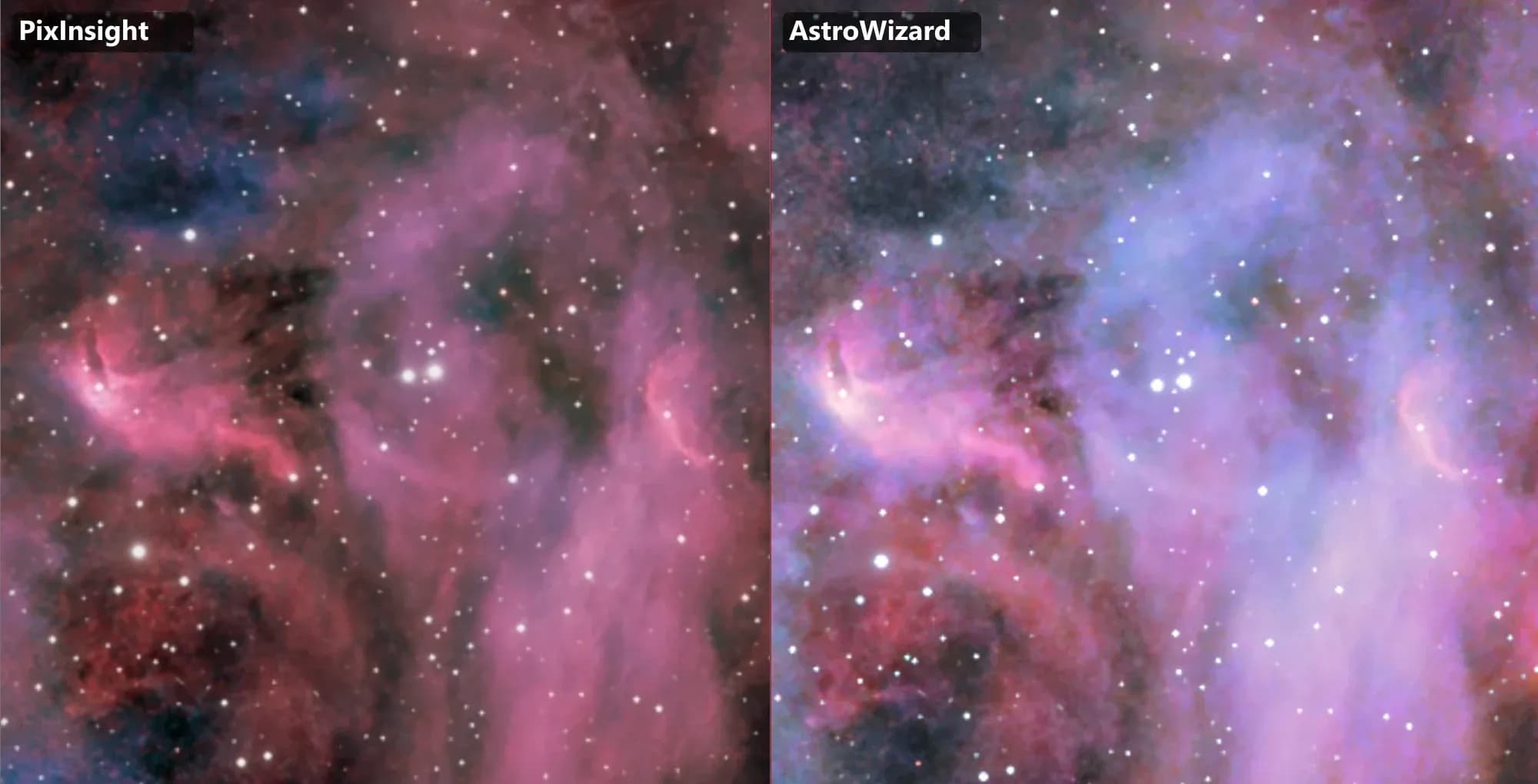
With PixInsight:
- colour control is finer: the hydrogen red dominates, while AstroWizard pulls the core towards lavender blue;
- details stand out more;
- edges are sharper, on the dark globules as well as the stars.
AstroWizard does a very good job in a few clicks. PixInsight takes practice, but keeps the edge for detail and colour.
My take
StackingWizard is now fast and reliable on mosaics, and the translations remove a hurdle for beginners. Edge feathering for mosaics is still missing. The stand-alone RC Astro tools bring top-level processing without PixInsight, but ML5 is paid for long-time customers.
If you've never processed your smart telescope's frames yourself, now is a good time to try.
Where to download them
- StackingWizard (free): astrowizard.lukomatico.com/stackingwizard.html
- AstroWizard (free): astrowizard.lukomatico.com
- RC Astro tools (paid, free trial): rc-astro.com
My StackingWizard and AstroWizard guides still apply. To report a bug, copy the log and send it to wizard@lukomatico.com (read-only mailbox, no reply). The "Support this project" button lets you donate to the author.