"Should I start with a smart telescope, or go straight for a real setup?" It is the question I get asked most. The answer depends on what you want to shoot, where you observe from, and above all your budget. And that is where comparisons get misleading.
A smart telescope shows an all-in price. The Seestar S50 Pro costs around €900 with the optics, camera, motorised mount, battery and app. An astrophotography refractor shows the price of the tube alone. An Askar 71F starts at €829, and at that point you have no camera, no mount and nothing to control them.
To compare like with like, I worked out the full costs, then turned them into a free tool on the site: the astrophotography configurator.
As for me, I started with a Seestar S50. It made me want a bit more detail and control over my images, hence my Askar setup alongside it, which also has the advantage of being upgradable.
The budget of a complete setup
Here is the setup I use for compact nebulae and galaxies, with the lowest prices found in France in October 2026:
| Item | Gear | Price |
|---|---|---|
| Scope | Askar 71F (built-in field flattener) | €870 |
| Camera | ZWO ASI 585MC Pro (cooled) | €860 |
| Mount | Juwei-14 | €600 |
| Control | ASIAIR Pro | €280 |
| Guiding | Mini guide scope and guide camera - reused from my old newton | about €300 |
| Filter | Quad-band light pollution filter SVBony SV260 | €189 |
| Misc. | Power, cables, dew heater | €100 |
| Total | €2,899 |
That is almost three times the price of a Seestar S50 Pro, without counting the computer used to process images, which you need either way.
You can go much lower by aiming at large nebulae with a small wide-field scope. That is the example I used to show the tool.
The configurator, step by step
1. Targets, then the scope
You start by saying what you want to shoot: large nebulae, compact nebulae, galaxies, clusters, or specific objects. You also give your sky (city, suburbs, countryside) and where you set up.
The tool then sorts the scopes by those targets. Each card shows a few plain-language labels ("Ready to shoot", "Needs a corrector", "Travel, light mount"...) and a light that tells you whether the field suits your targets. The small question mark next to each technical term gives a short explanation.
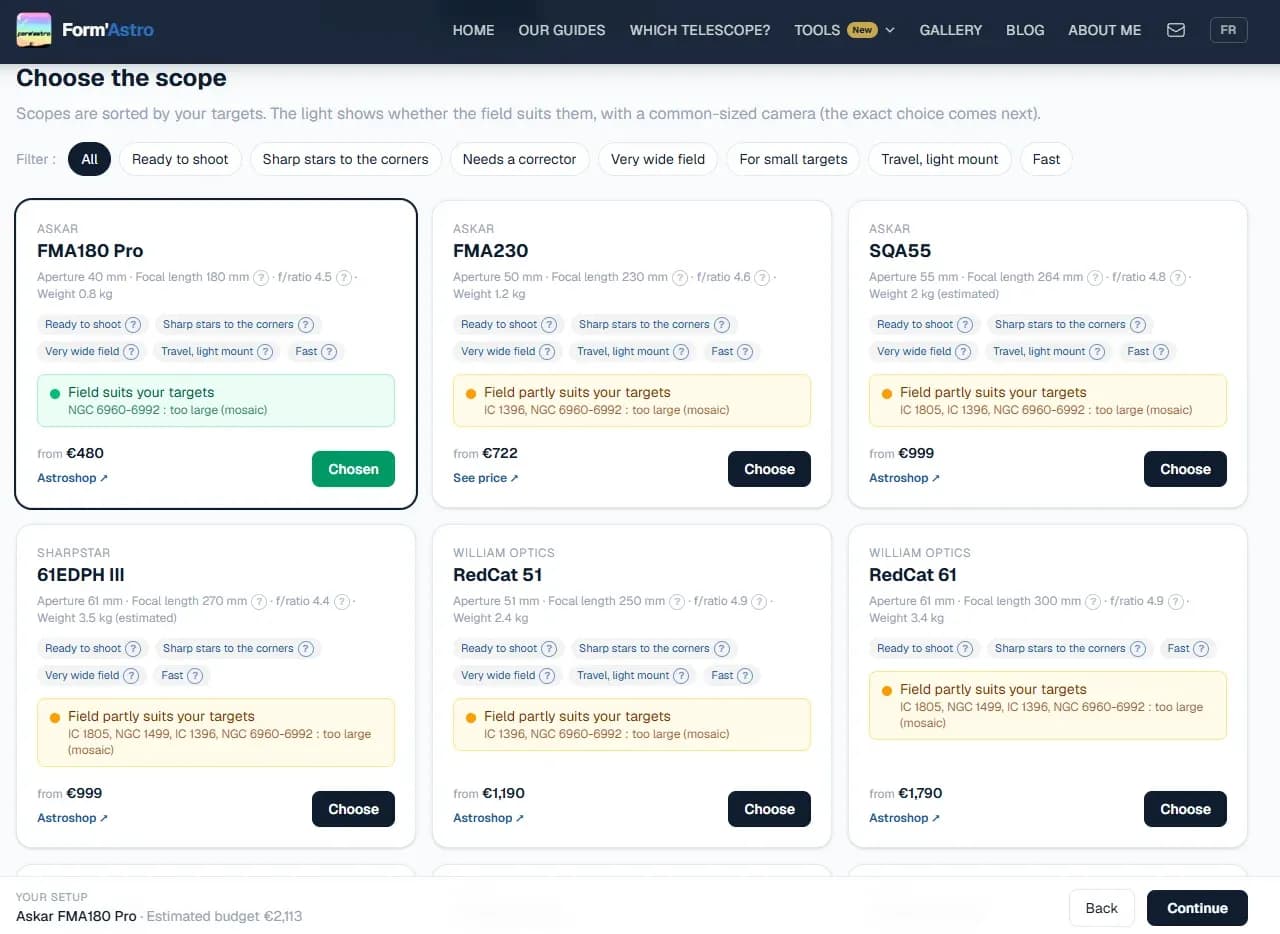
For large nebulae, the Askar FMA180 Pro comes out on top: only the Veil Nebula overflows the frame. With longer focal lengths, more targets need a mosaic and the light turns orange.
2. The camera, then the mount and accessories
At the next step, three lights check that each camera works with the chosen scope: image detail, sensor coverage and framing of your targets. For the example, I picked an SVBony SV605CC, a cooled camera at €559.
Then comes the part comparisons often leave out: the mount and accessories. The tool picks a mount that carries the setup with a margin, then ticks the recommended accessories. You untick what you already own, tick what you want, and the budget updates.
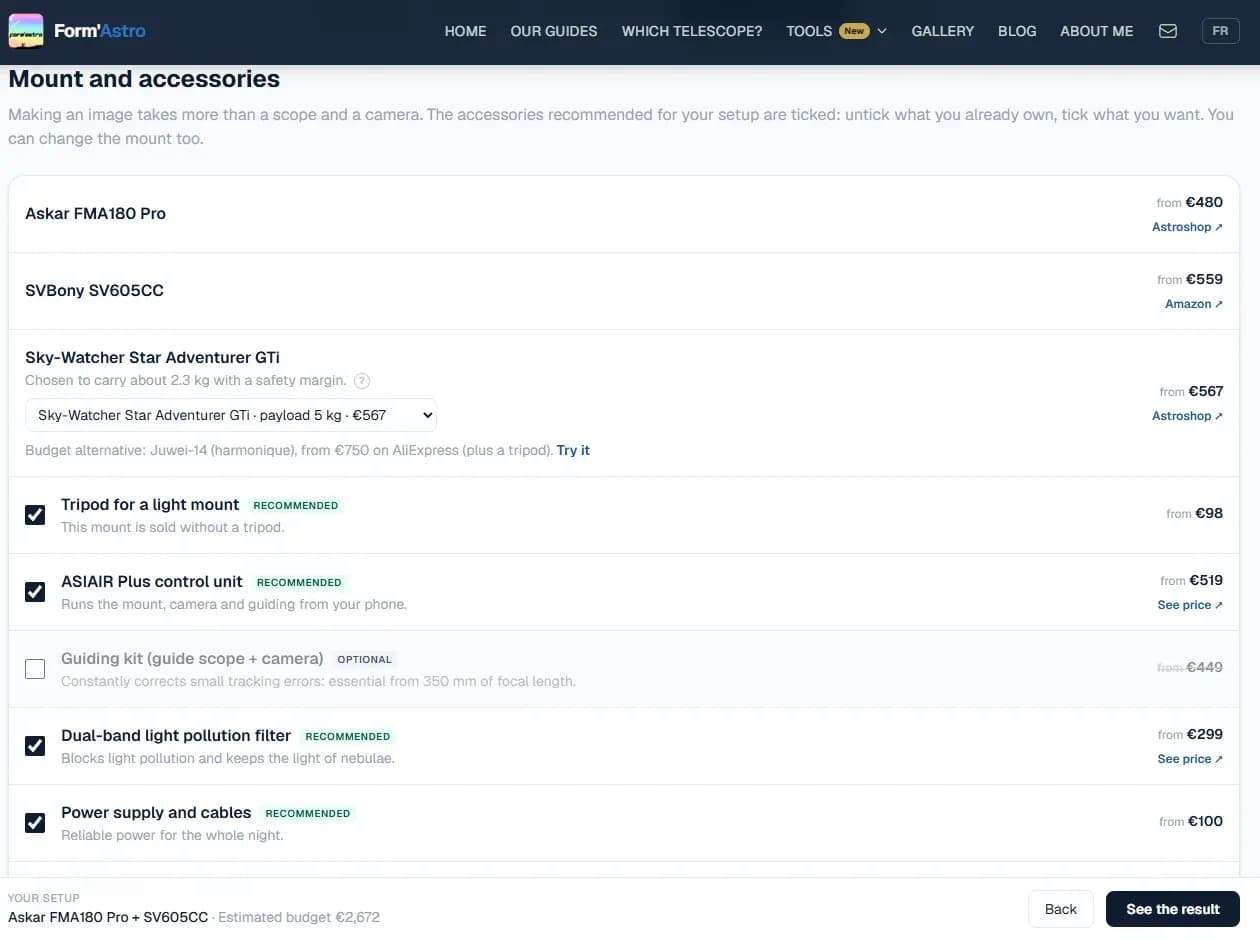
Here, the Star Adventurer GTi is picked automatically: at 180 mm of focal length, the setup weighs only about 2.3 kg and guiding is optional. The full budget is then €2,672. The tool also suggests the Juwei-14, a harmonic mount sold on AliExpress, and warns that these mounts come without a tripod, with possible shipping and customs fees and remote after-sales support.
3. The result against smart telescopes
The last step places your setup and two smart telescopes on a real sky image: the one with the closest field of view, and the Seestar S50 Pro as a reference. A table then compares budget, field of view, detail, light collected, setup time and learning curve.
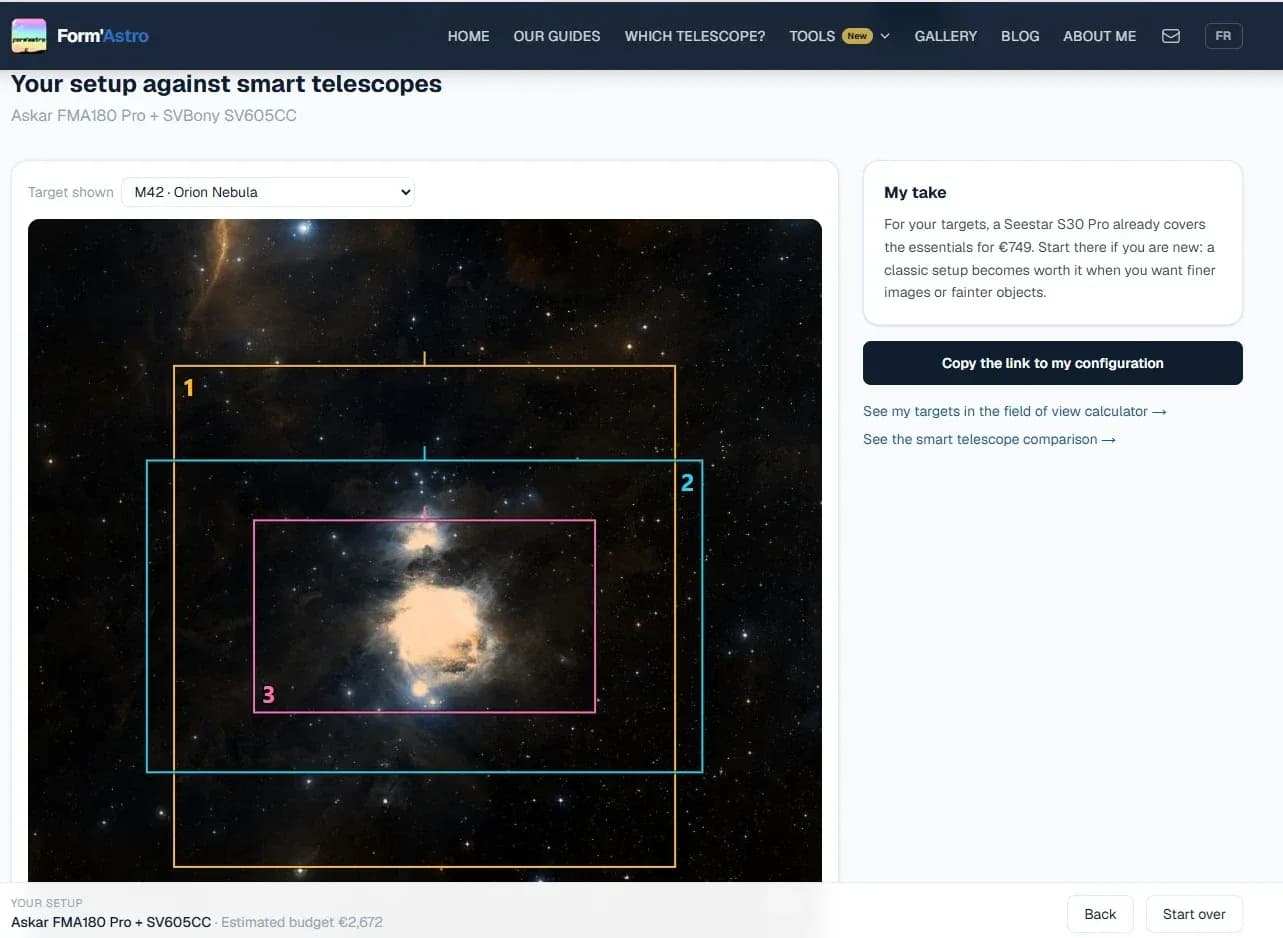
And the tool gives its take. Here it is clear: for large nebulae, a Seestar S30 Pro at €749 already covers the essentials. A classic setup becomes worth it when you want finer images or fainter objects. That is on purpose: a tool that always recommends the most expensive gear would be useless.
You can copy the link to your configuration to come back to it later or share it.
What a classic setup brings
- More light. It mostly depends on aperture. The Askar 71F's 71 mm collect about 2.3 times more light than a Seestar's 50 mm for the same exposure time: less noise, and faint areas show up sooner.
- More detail. With the ASI 585MC, each pixel covers 1.22 arcseconds, against 2.30 for the Seestar S50 Pro. On a galaxy, the difference shows immediately.
- Real tracking. A guided equatorial mount allows exposures of several minutes, without field rotation.
- Gear that grows. You can change the camera or the scope without buying everything again.
What the smart telescope does just as well
- Setup: five minutes, against 20 to 30 for a classic setup (polar alignment, balancing, focusing, guiding).
- Learning: one evening is enough. A classic setup takes weeks.
- Travel: about 2.5 kg in a backpack.
- Large bright nebulae: the gap shrinks a lot, especially with good processing.
To me, they are complementary tools. Thinking that better-performing gear sends the Seestar to the back of the cupboard would be a big mistake: its simplicity, compactness and portability are real strengths. And above all, as you can see in the gallery, you can get really nice pictures with the S50.
The real question is: what does this setup offer now, following the release of the S50 Pro? Aside from the aperture, the sensor is very similar (though it’s not an IMX585, mind you), and everything comes integrated by default... In reality, the arguments presented above still hold true. Larger is better !
My duels on real images
I shot the same objects with my Seestar S50 and with the Askar 71F. Exposure times and processing are not identical, so these are not lab tests, but they give a good idea of the gap.
To make the comparison readable, the Seestar image is enlarged and rotated to sit exactly on top of the Askar one. Drag the slider.
M 33, the Triangulum Galaxy
Askar: 39 exposures of 5 min (3 h 15), processed in PixInsight. Seestar: 486 exposures of 20 s (2 h 42), processed in Siril.
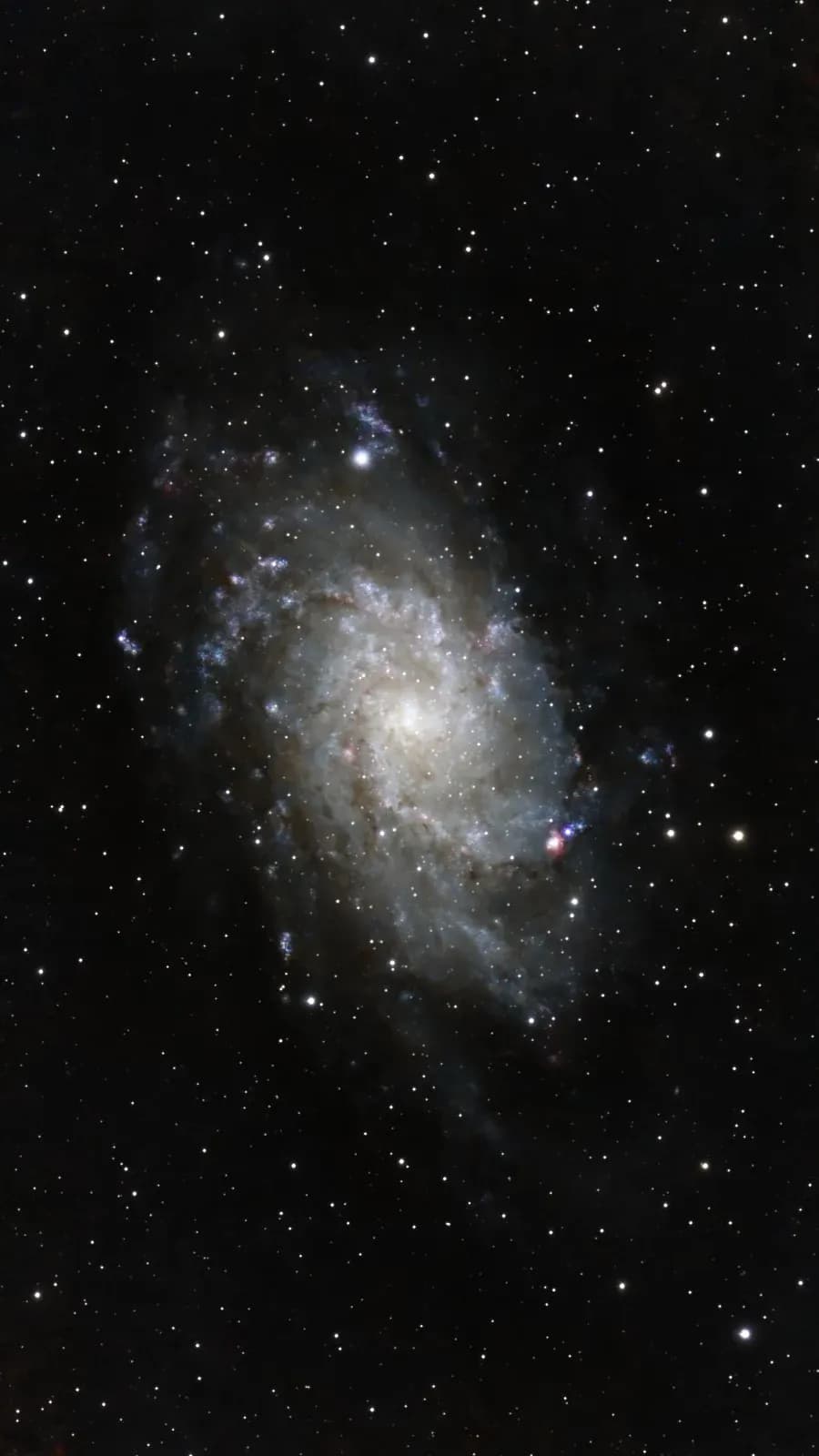
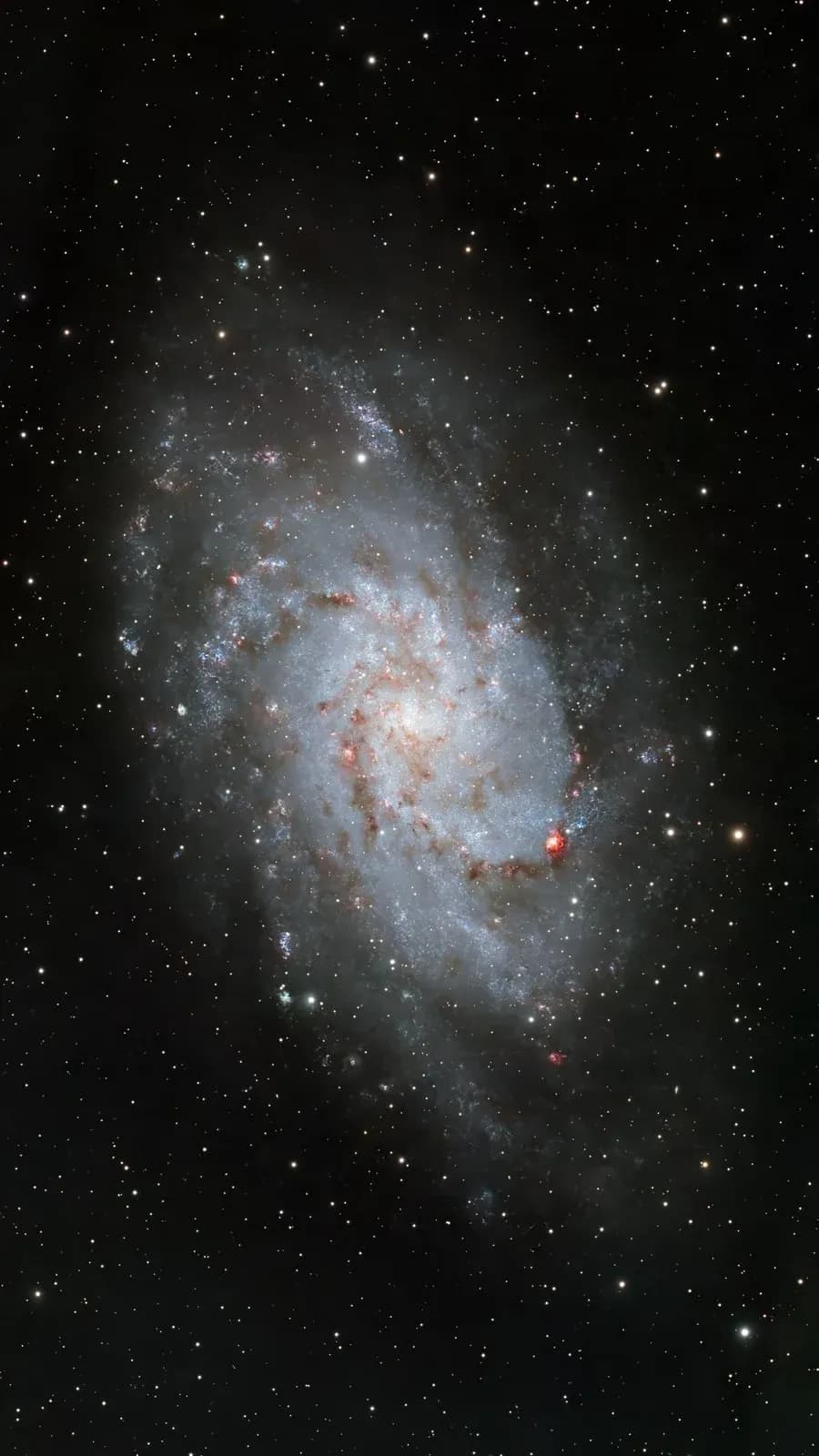
A galaxy is where the gap shows most. With the Askar, the arms stand out clearly, the red star-forming regions show up and stars stay small. The Seestar shows the overall structure well, but everything is softer.
NGC 6729, in Corona Australis
Askar: 37 exposures of 5 min (3 h 05). Seestar: 607 exposures of 20 s (3 h 22).
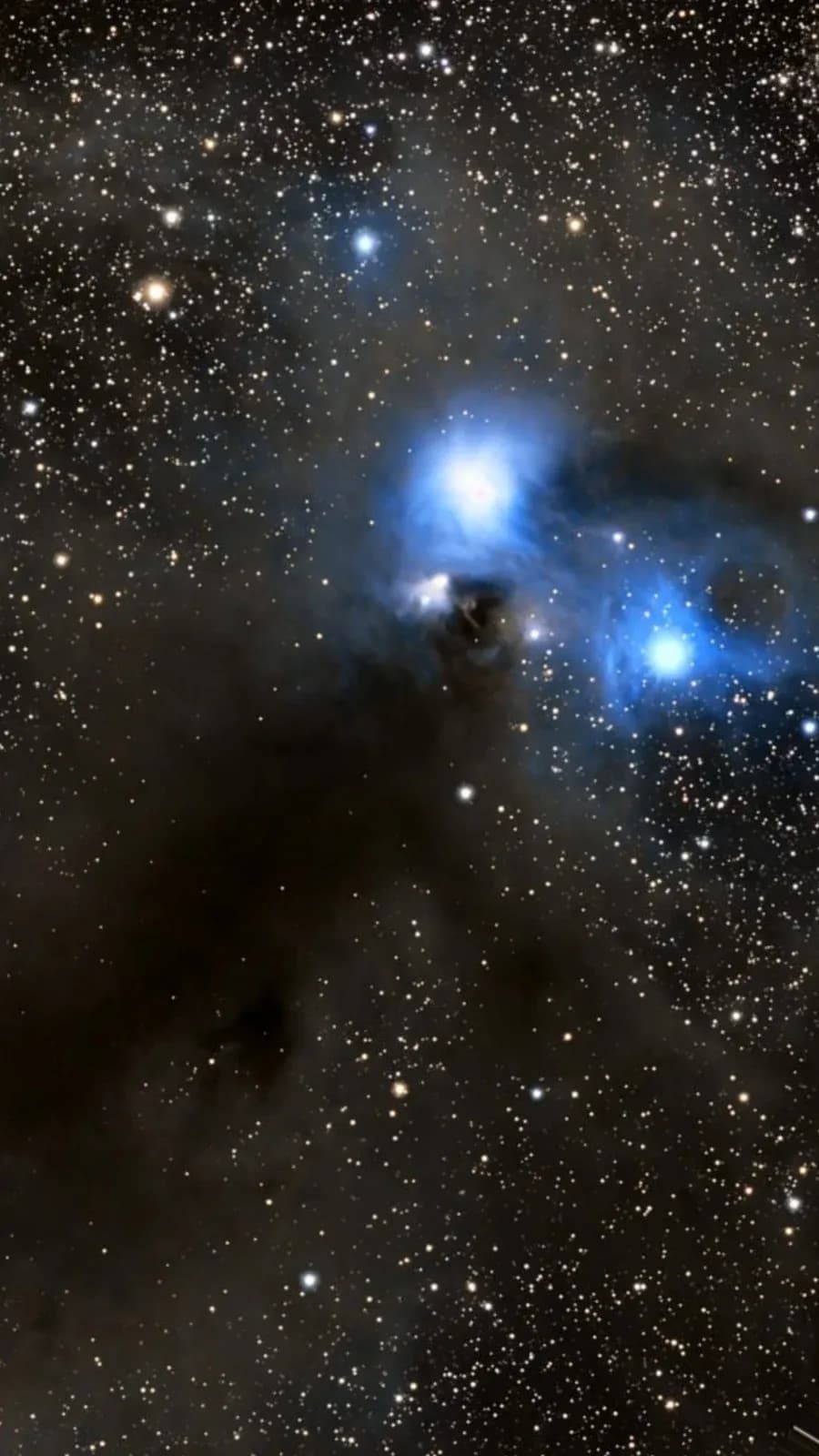
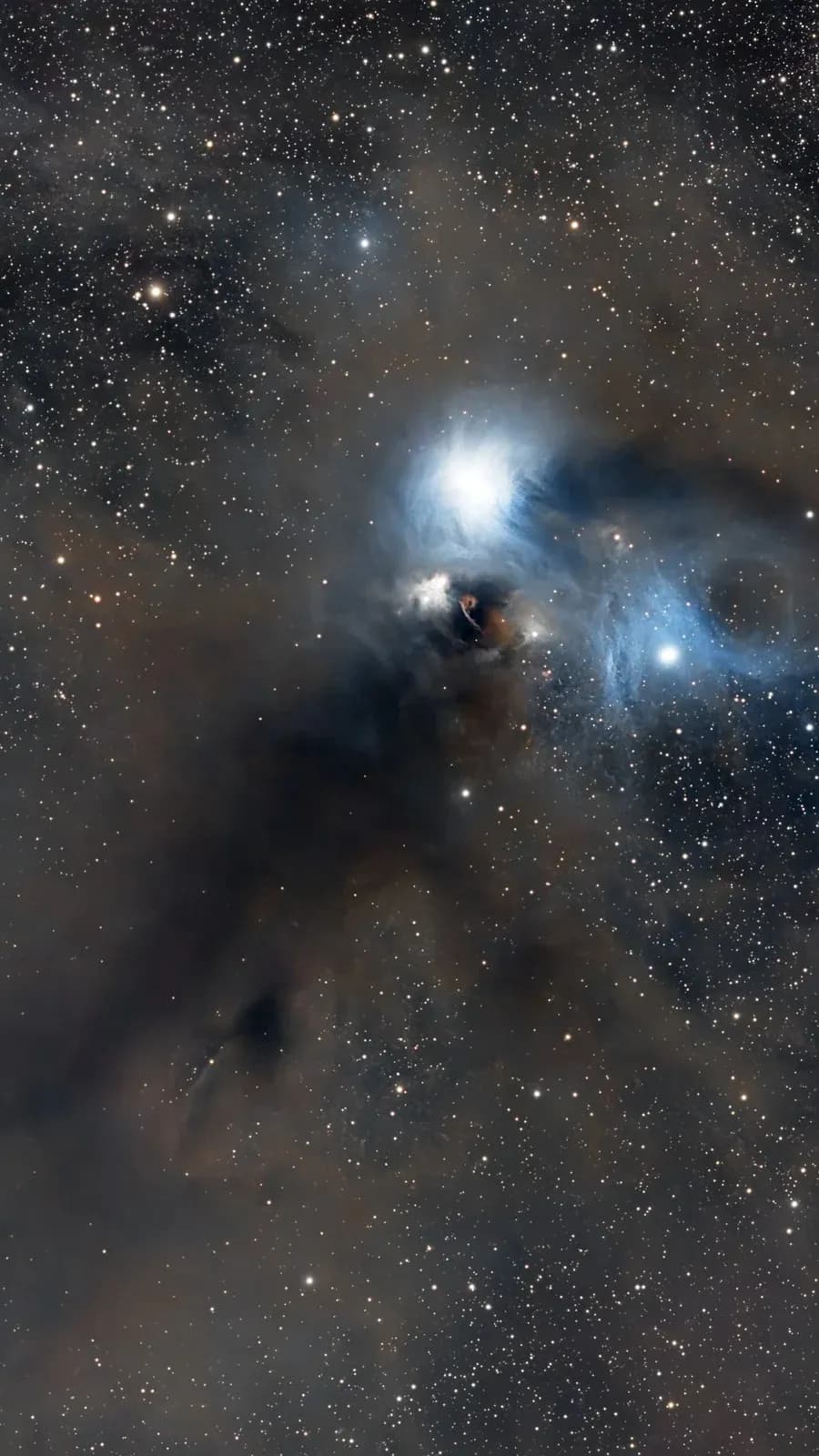
Here the gap shrinks. The blue reflection nebulae and the dark clouds are there on both images. The Askar mostly brings more detail in the dust and around the small variable nebula in the centre.
Which one to choose?
A smart telescope if:
- you are new and want images from the first night;
- you observe from a balcony or while travelling;
- your budget is under €1,000;
- you mostly aim at large nebulae.
A classic setup if:
- you aim at galaxies and small nebulae, where detail matters;
- you have a garden and time to learn;
- you want to upgrade your gear piece by piece.
Many do both: a smart telescope to start and travel, then a classic setup when they want to go further.
In the end, the Askar is well ahead, granted, but at what price. The choice is yours ;)
To build yours: astrophotography configurator. You can also check what each smart telescope frames on your targets with the field of view calculator, and compare the 13 current models in the comparison.
Frequently asked questions
Does a classic setup always give better images?
Well tuned and well processed, yes, especially on small objects. But a badly tuned setup (focus, tracking, sensor tilt) gives worse images than a smart telescope that handles everything on its own.
Can I start with a regular camera?
Yes, if you already own one. A mirrorless or DSLR camera, ideally astro-modified, on a small wide-field scope and a mount like the Star Adventurer GTi is a very good start. The configurator offers this option, without counting the camera in the budget.
Are mounts sold on AliExpress worth it?
Harmonic mounts like the Juwei-14 and 17 cost much less than their branded equivalents. In return, the price varies by seller, you need to add shipping and sometimes customs, and after-sales support is remote. They also come without a tripod.
Are the prices up to date?
They are the lowest prices found at French retailers in October 2026. They change: the configurator shows them as "from" and I update them regularly.